

You’ve had this argument. Maybe last week. Freemium or free trial? Ask for the card up front, or keep the funnel frictionless and hope the product does the closing?
It’s a good argument. It’s also, mostly, beside the point.
A team that ran 514 experiments in a single year found that the format was never the lever. What moved their number was a screen most growth teams would have argued themselves out of shipping — and the argument against it would have sounded like good judgment.
If you’re staring at an 8% free-to-paid rate wondering whether that’s fine, here’s the mechanic, the numbers, and the part worth copying.
The number that stops you
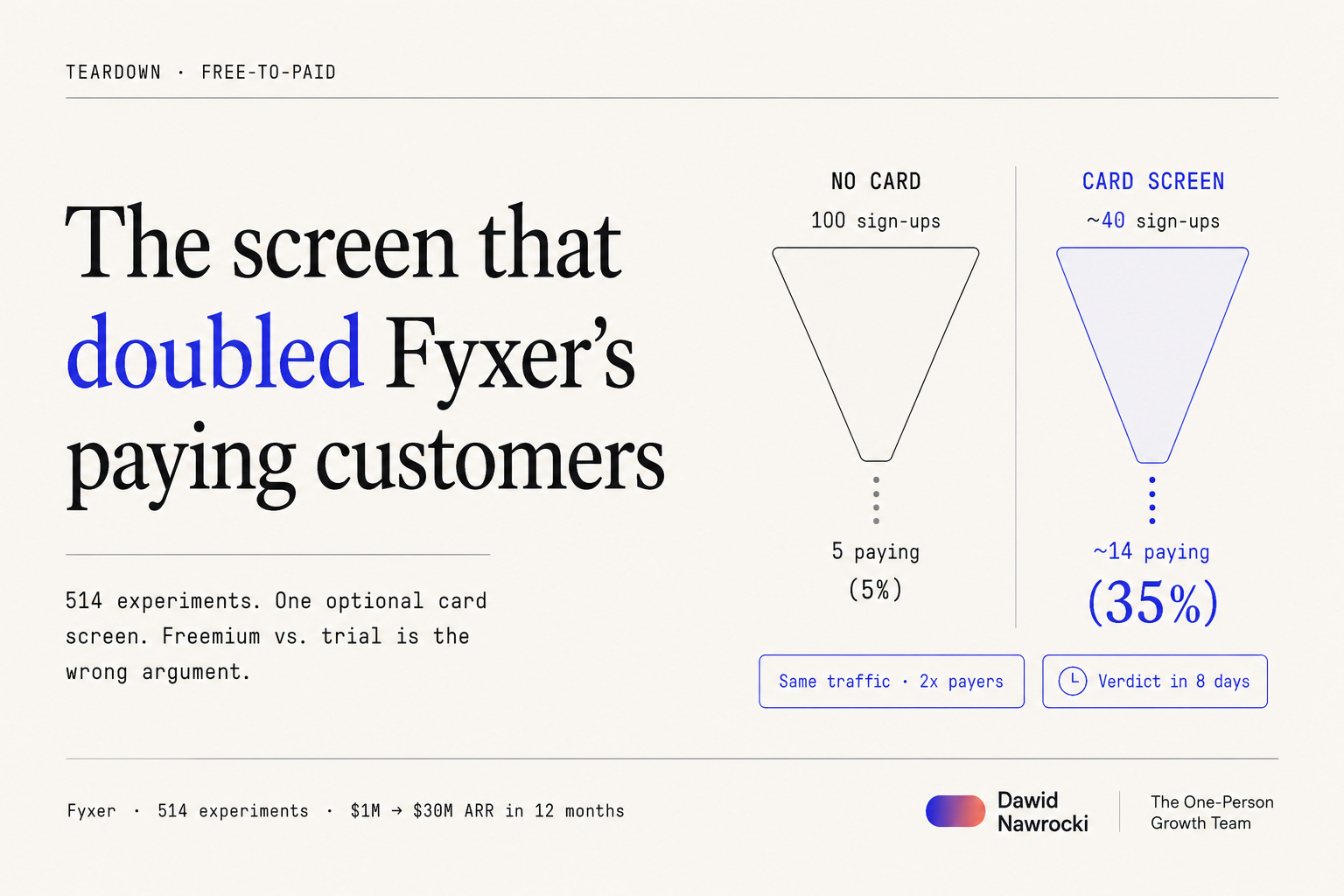
Fyxer added an optional credit-card screen to their trial.
Sign-ups went down. Conversion went from 5% to 35%. Paying customers doubled on the same traffic. The experiment resolved in eight days.
Read that again slowly, because the shape of it is the whole lesson: fewer people entered the funnel, and more people paid. That only reads as a paradox if you’re counting the wrong thing.
Worth noting where this came from. This wasn’t a marketing brainstorm or a “what if we tried” in a Monday standup. It came out of a growth-engineering team — Kameron Tanseli’s — that treats the funnel as a system with instrumentation, not a set of opinions to be defended.
Why it works — the mechanism, not the trick
A credit-card field is not friction. It’s a qualification gate.
What it does is trade raw sign-up volume for intent. Someone who types in a card — even when they’re told they don’t have to — has made a small, private decision about whether they expect to pay. Everyone downstream of that field is a different population than the one you had before. Your conversion rate didn’t improve because your product got better in eight days. It improved because you stopped measuring against tire-kickers.
This isn’t a one-company anecdote, which is the part that should make you take it seriously. The 2026 Free-to-Paid Report — Kyle Poyar with ChartMogul and ProductLed, across roughly 200 products — found card-required trials convert around 5x higher than card-free ones. Fyxer’s 5%→35% sits neatly inside that benchmark rather than out on some lucky tail.
And here’s the finding from that report that should reframe how you read your own dashboard: median free-to-paid conversion is about 8%, but the top 20% of products convert around 10x the bottom 20%.
That spread is enormous. It means “are we good?” is a question with no useful answer — the median tells you almost nothing about where the ceiling is. The better question is which side of the mechanics are we on? Because a 10x gap isn’t a talent gap. It’s a gap in what’s been tested.
It was a system, not a screen
The card gate is the headline, but it’s the least interesting thing here in isolation. What matters is that it sits in a log alongside a dozen other moves, each one a small piece of evidence that this was engineering rather than luck:
Annual plan as the default, with the price shown as an effective per-month figure and a 25% discount. Result: 2.3x more annual trials. Roughly half of paying customers now take annual — which is a cash-flow and retention change disguised as a pricing-page tweak.
A new Pro tier at $50/user, up from a $30 list price. Revenue per trial went up 67%. Checkout completion fell by 6%. That trade is not close, and you only know the shape of it because someone shipped it and watched.
Trial length segmented by time-to-aha. Three days produced instant cancellations. Seven days worked best overall. But users signing up with personal email addresses needed 14 — they were slower to reach the moment where the product proves itself. Trial-start rate moved from 13.4% to 22.1%. Note what happened there: the answer wasn’t “shorter” or “longer,” it was “depends who,” and you can’t find that without segmenting.
And then the honest one. Social proof added to the “connect your email” step: 57.1% → 59.8%.
That’s a 2.7-point lift. Real, worth keeping, thoroughly unglamorous. I’m including it on purpose, because a set of results where everything is a doubling isn’t a log — it’s a highlight reel. Most experiments land here. The card gate is memorable precisely because most weeks don’t produce one.
The actual moat
514 experiments in twelve months. A team of four. That’s roughly 90 per engineer per year — call it two a week, every week, with no dead months.
Here’s the part I’d underline: no single test in that log is the strategy. The rate of testing is.
Nobody sat in a room and reasoned their way to “an optional credit-card field will 7x our conversion.” The idea is counterintuitive on its face — a reasonable person would predict it kills the funnel, and a reasonable person would be right about sign-ups. You don’t guess your way to that screen. You build an engine that surfaces it, then you have the discipline to count the right metric when it does.
Which means the constraint in your funnel probably isn’t ideas. You almost certainly have a backlog of them. If you run two experiments a quarter, you will never find your version of that screen — not because your hypotheses are worse, but because eight shots a year is not enough shots. Throughput is the moat. Everything else is downstream of it.
Count payers, not sign-ups. Then build the experiment engine that finds the one screen you’d never have guessed.
I build these experiment systems for a living — if your free-to-paid number has been stuck, that’s usually the work. Reply to this email and tell me where it’s stuck.