

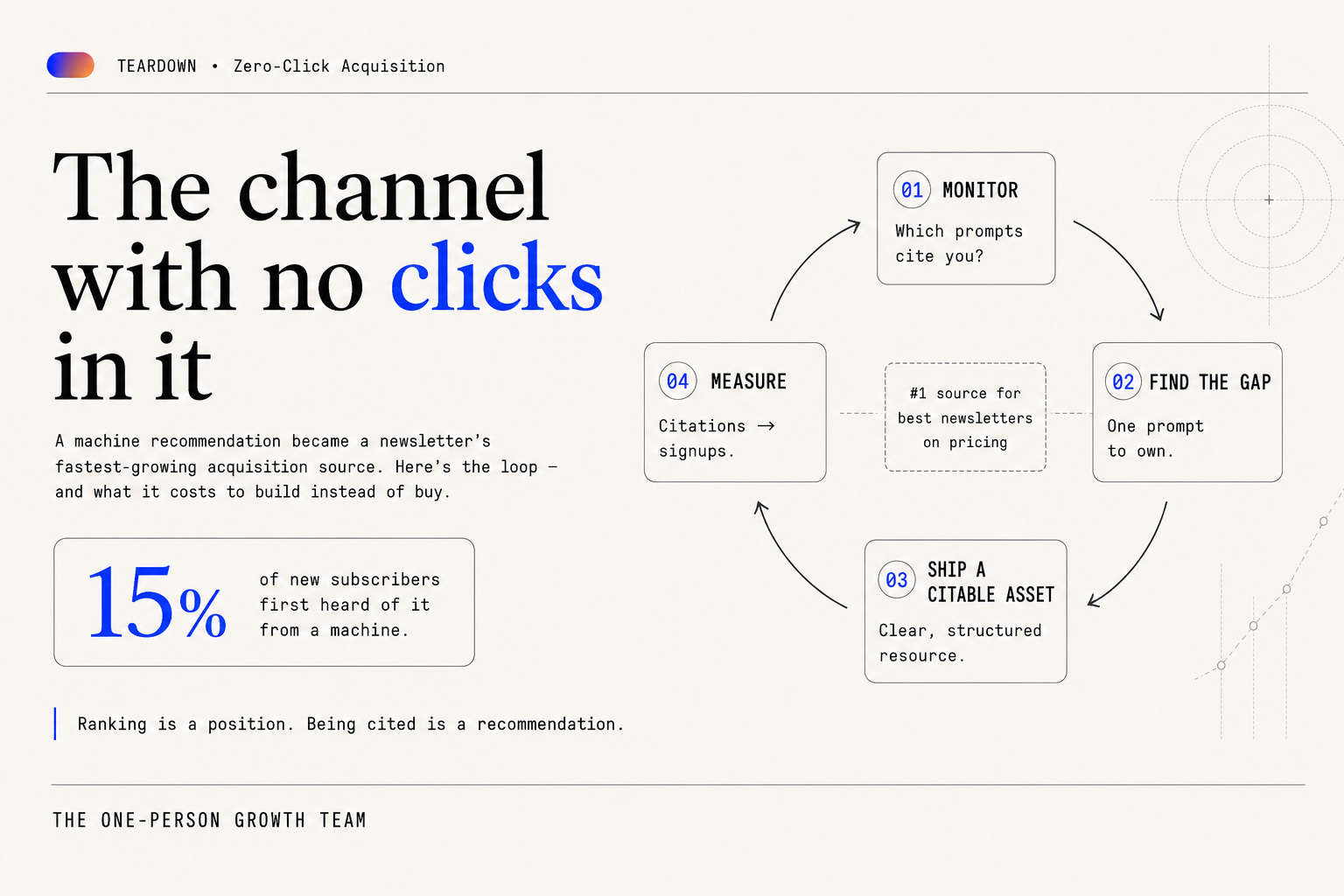
Fifteen percent of new Growth Unhinged subscribers now say an LLM is where they first heard of it. Not a search result. Not a referral link. A machine made the recommendation, and a human acted on it.
The same person who filed this under “snake oil” a year ago now calls it his fastest-growing channel.
That’s worth taking apart. Because if your fastest-growing visitor isn’t human, the funnel you’ve spent three quarters optimizing has a blind spot sitting right at the top of it.
The shift
Automated traffic is growing roughly 8x faster than human traffic. (Secondary source — take the number directionally. Nobody’s arguing about the direction.)
Here’s what that does to the buyer: the shortlist gets built before anyone lands on your site. By the time you see a visit, the evaluation is half over. And you cannot A/B test your way onto a list you were never on.
The reframe that does the work here:
Ranking is a position. Being cited is a recommendation.
SEO earns you a slot to be evaluated in. Citation earns you the endorsement — the machine speaks on your behalf, and the buyer treats it as an answer rather than a result.
One note before I go further: Kyle’s post is a paid #profoundpartner placement. I’m not selling you the tool. I’m showing you the loop, which is vendor-agnostic — and, as it happens, buildable in a weekend.
The teardown
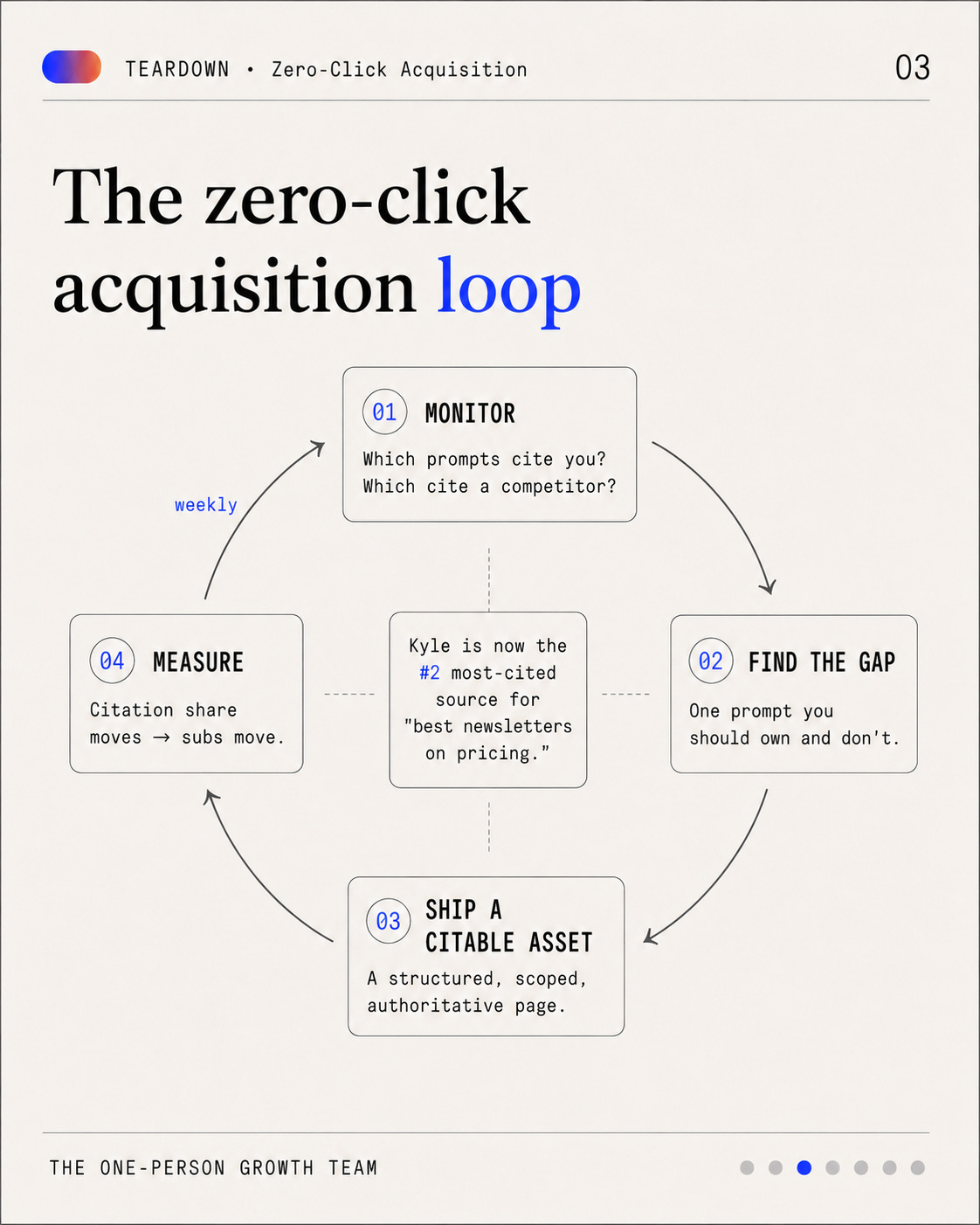
Four nodes, and the arrows matter more than the boxes.
1. Monitor. Which prompts cite you. Which cite a competitor. Who’s overtaking you, and how fast.
2. Find the gap. Exactly one prompt per week you should own and don’t. One. Discipline beats coverage here — a coverage strategy turns into a content sprint, and content sprints die the way content sprints always die.
3. Ship a citable asset. A structured, scoped, authoritative page built for that one prompt. Kyle’s was a pricing-resources hub. He is now the #2 most-cited source for “best newsletters on pricing,” with HubSpot closing in behind him.
4. Measure. Citation share moves → signups move. Then you go again.
The part most people miss isn’t in any of the four nodes. It’s in the loop itself: this is a system, not a campaign. Campaigns decay. Loops compound.
What actually makes a page citable
A real “last updated” date. Roughly +15% citation uplift (Kevin Indig’s number). The cheapest growth lever on this list is a date field. Go add it.
Answer-first structure. The answer in the first two lines, not in paragraph six. Machines quote the top of the page.
Hyper-specific intent over keyword volume. Incumbents win the broad terms on brand priors. You win the specific ones — the ones your buyer actually types when they’re three days from a decision.
Structure a parser can read. Clean headings. Real data. No FAQ buried in an accordion.
And the caveat that will save you a wasted month: none of this rescues a page with nothing original in it. Machines cite sources, and a source needs something of its own to say — a number, a dataset, a teardown. Formatting is the delivery mechanism. It is not the payload.
Buy vs build
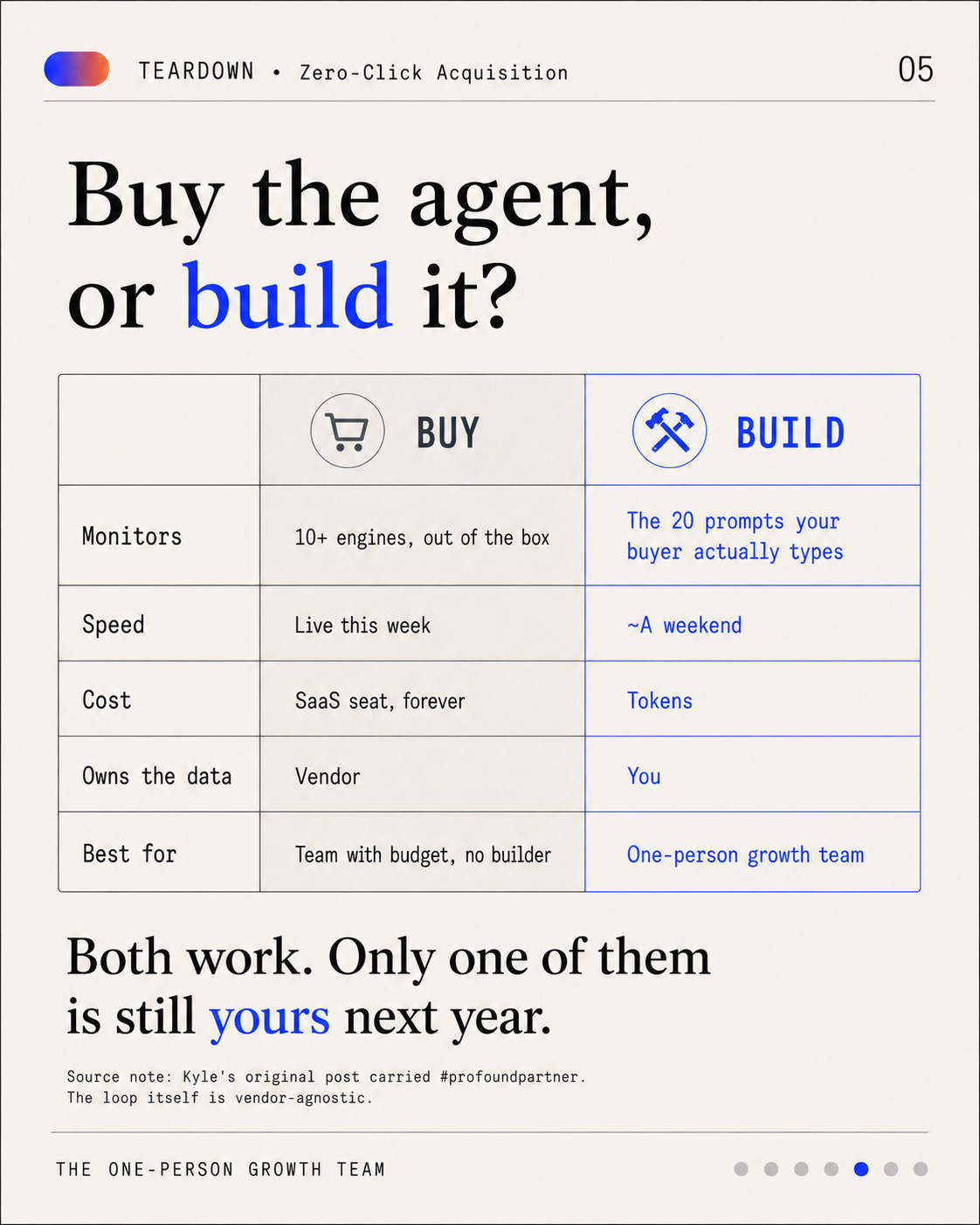
Buy (Profound-class agents): live this week, 10+ engines monitored, vendor owns the data, recurring seat cost. The right call if you have budget and nobody who builds.
Build (n8n + Claude + your warehouse): a weekend of work, monitors the 20 prompts your buyer actually types, costs tokens instead of seats, and the data stays yours. The right call for a lean team with one person who ships.
The honest trade-off: buying gives you breadth, fast. Building gives you depth, cheap, and owned. The mistake isn’t picking the wrong one — it’s picking neither and calling it “we’ll do SEO.”
One more layer worth naming, because nobody has cracked it: AI-influenced revenue attribution. Visibility tools are everywhere. Revenue mapping isn’t. When your CMO asks what AEO made you this quarter, the honest answer today is a heuristic, not a number. Whoever fixes that is going to do very well.
The one thing to keep
AEO is the first acquisition channel where the entire loop — detect, brief, draft, measure — can run as a background agent. Detection is an API call. The brief is a prompt. The draft is a prompt. The measurement is a cron job.
A channel that used to require an SEO team is now a one-person channel.
That isn’t a metaphor for the thesis of this newsletter. It is the thesis, finally showing up in a real place.
I build these loops for growth teams. If you want to know whether you’re the cited answer in your category, reply with your category and I’ll tell you what I see.