

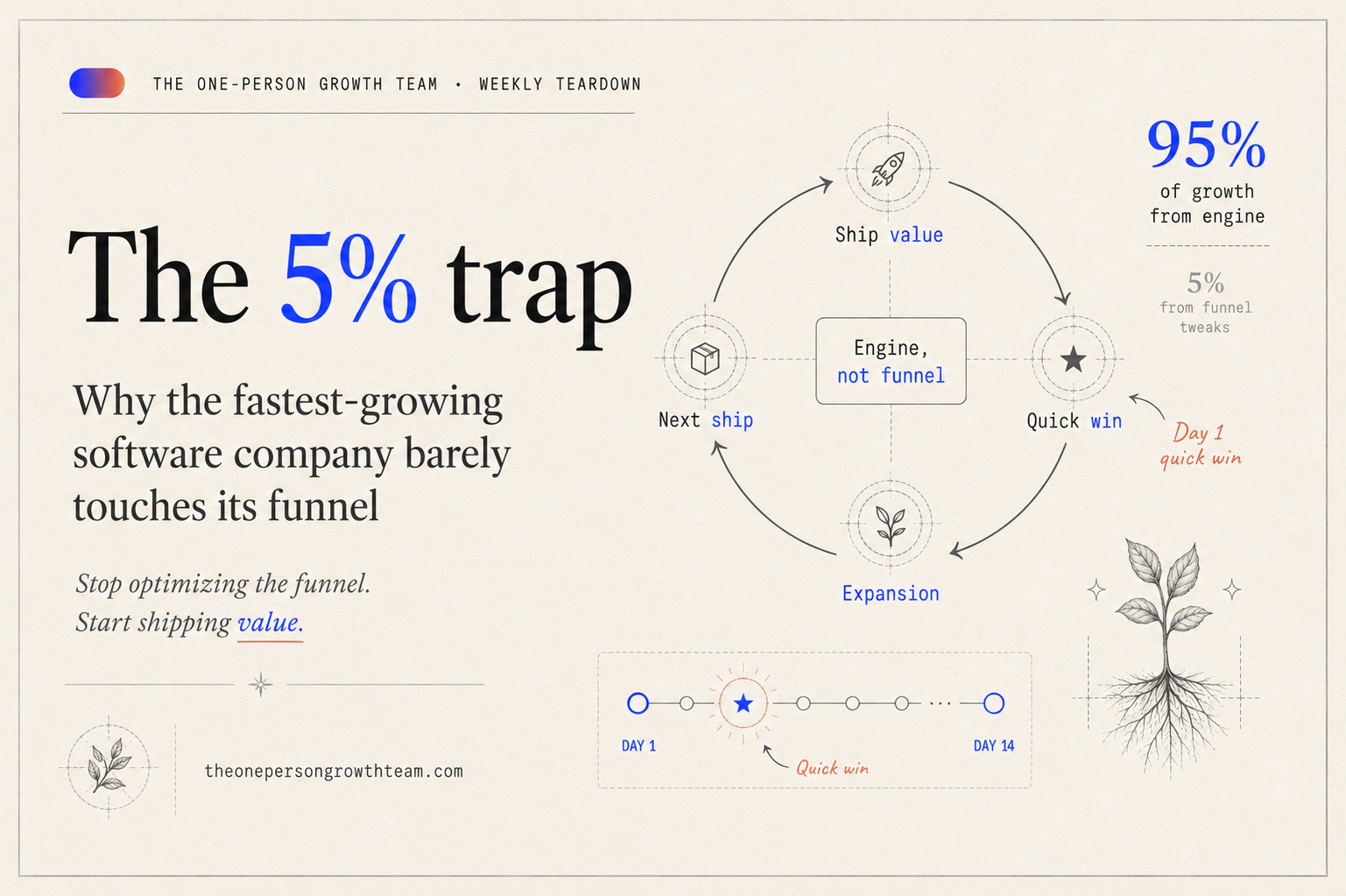
If you run growth right now, your calendar probably looks like this: two A/B test reviews, an onboarding tweak standup, a CRO sync. Real budget, smart people, full sprints — and the growth curve is still flat. Here’s the uncomfortable explanation: in 2026, the fastest-growing companies treat funnel optimization as a small lever and put their weight on shipping value and activating users on it fast. This week: two real teardowns. One company that quantified the funnel as a 5% lever at $200M ARR, and one that rebuilt onboarding around a single quick win. This will feel wrong if you were trained on AARRR. Read it anyway.
The hero teardown: Lovable’s 95/5 engine
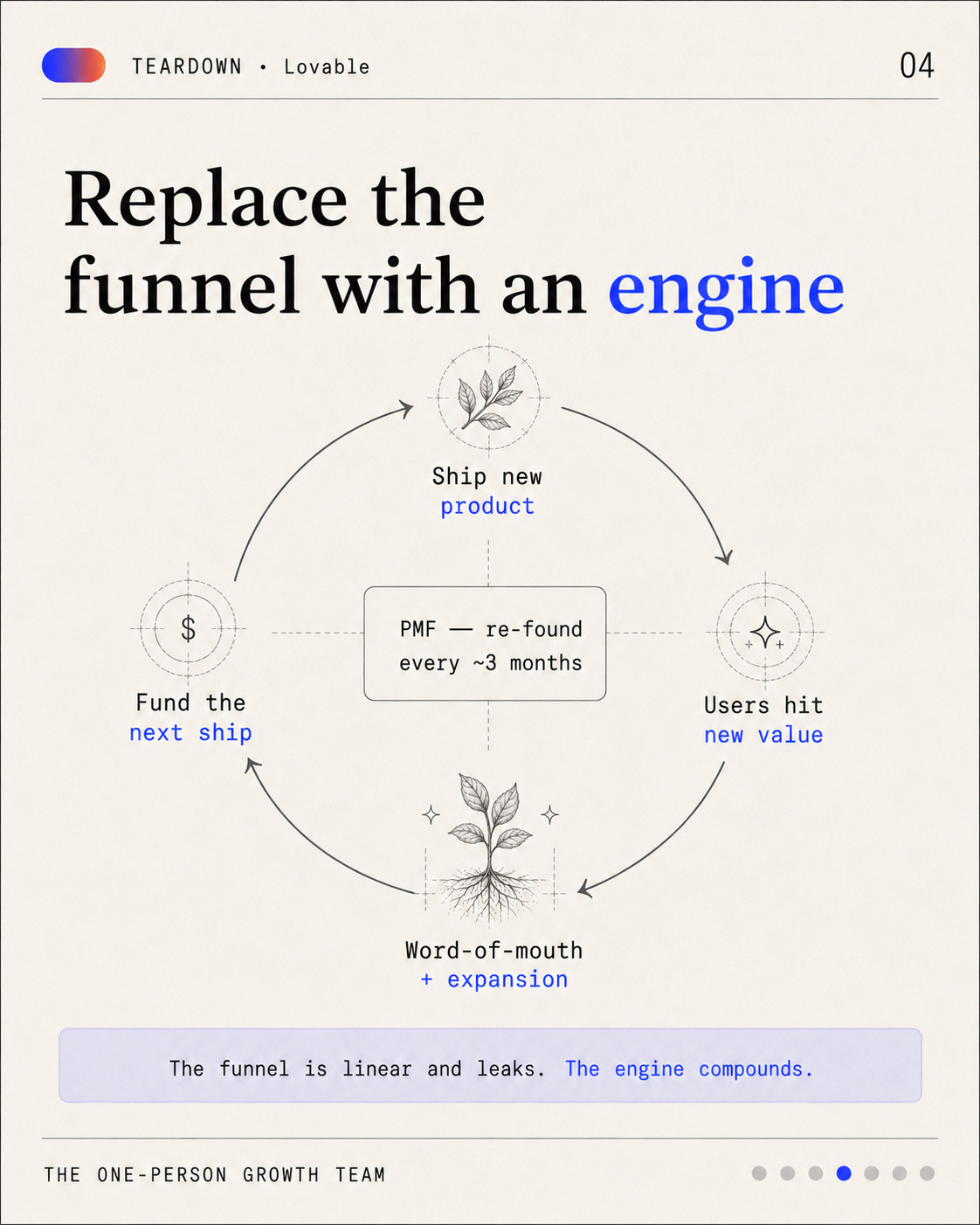
Start with the number, because it earns the thesis: Lovable hit $200M ARR in under a year with roughly 100 people — and by their own growth lead’s account, the team spends about 5% of its effort on funnel optimization and 95% on shipping new product and new growth loops. That’s not neglect. It’s a deliberate allocation at the fastest-scaling software company we’ve seen.
The mental model shift is funnel → engine. A funnel is linear and leaky: pour traffic in the top, lose most of it, optimize the leaks. An engine is a loop: every ship creates something to talk about, the talk brings builders, the builders create output that markets the product, and the cycle funds the next ship. When your product changes weekly, squeezing 3% out of a signup page is a rounding error against launching the thing that re-activates your entire dormant base.
Two structural moves make it work, and both are things buyers consistently miss. First, activation was moved out of growth and into product. Lovable’s growth team barely touches onboarding — because activation is the moment the product delivers a stunning result, and that’s a core-product problem, not a tooltip problem. Second, the core product is given away free as the distribution channel. Free credits aren’t a cost center; they’re the marketing budget. Someone wants credits to run a hackathon? That’s a campaign you didn’t have to build.
The operator translation, if you run growth at a scaling company: cap your funnel spend, fund shipping, and re-test PMF every quarter — Lovable operates as if product-market fit has a three-month half-life, because in AI markets it does.
The honest caveat: this doesn’t mean fire your CRO team. It means stop calling a 5% lever your growth strategy.
The mechanism: Apollo’s Velocity → Value onboarding
If shipping value is the engine, activation is where the user first feels it. Here’s what “activate on value” looks like operationally.
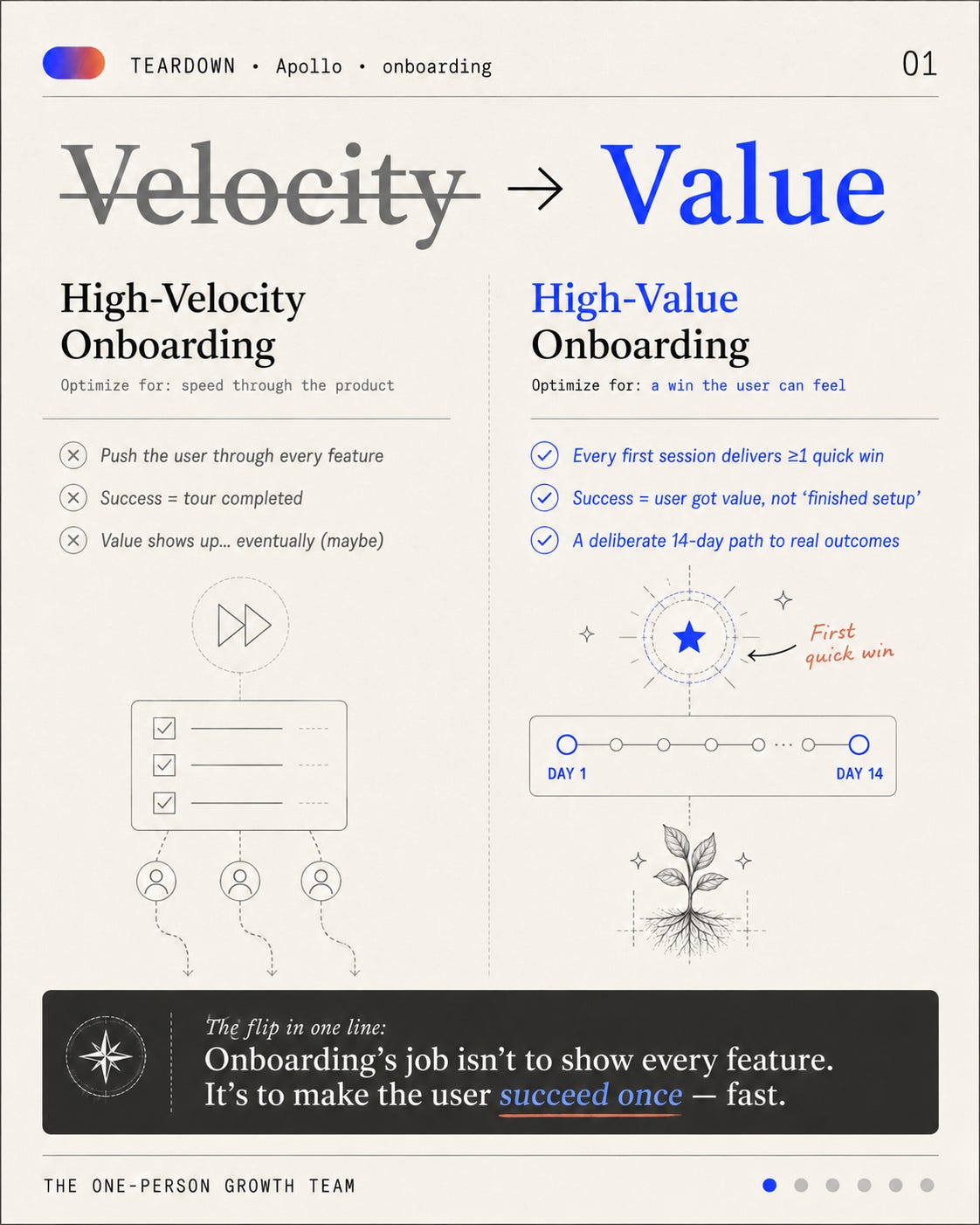
Apollo renamed its onboarding from High-Velocity to High-Value [VERIFY against Pill 2 source before send] — and the rename was the decision. Velocity onboarding optimizes for motion: steps completed, tooltips clicked, checklists cleared. Value onboarding optimizes for one thing: did the user get an outcome?
The flip has three parts. Every first session must deliver at least one quick win — a real outcome, not a configured setting. Success is redefined as the outcome, not “tour completed.” And instead of front-loading everything into day one, there’s a deliberate 14-day path [VERIFY] that sequences the next wins so momentum compounds instead of stalling after signup.
The durable line to keep: a user who clicked through 12 tooltips and felt nothing hasn’t activated — they’ve just been busy.
The through-line + this week’s one action
Same thesis, two altitudes. Lovable is the strategy: move activation into product and make shipped value the engine. Apollo is the mechanism: what activating-on-value actually requires, session by session.
Your one action this week: name the single quick win your product delivers in session one. If you can’t name it, that’s your highest-leverage work this quarter — not another funnel test.
Reply or comment “ENGINE” and I’ll send the one-page template I use to map any company’s growth engine (funnel vs loop), plus the 3-question quick-win onboarding audit.
I build these systems for a living — activation, growth loops, and the plumbing behind them. If that’s the problem sitting on your desk right now, just reply to this email.
— Dawid