

In 2026, the cheapest growth win isn’t a better ad, a new channel, or a pricing tweak. It’s speed at the moment of intent — the minutes (or seconds) between “someone raised their hand” and “someone useful responded.” Two things happened this month that prove it at opposite ends of the spectrum: a $1B public company rebuilt its entire funnel around agents, and I shipped the same play, solo, in a weekend. This issue breaks down both — and the three moves worth stealing regardless of which end you’re on.
The teardown: how monday.com made activation an agent
monday.com didn’t bolt a chatbot onto their funnel. They rebuilt first-touch around three agents, each owning one stage: Amanda works top-of-funnel qualification, Jax owns activation, and Oscar handles expansion signals. Each one has a number attached to it — not “engagement,” but pipeline.
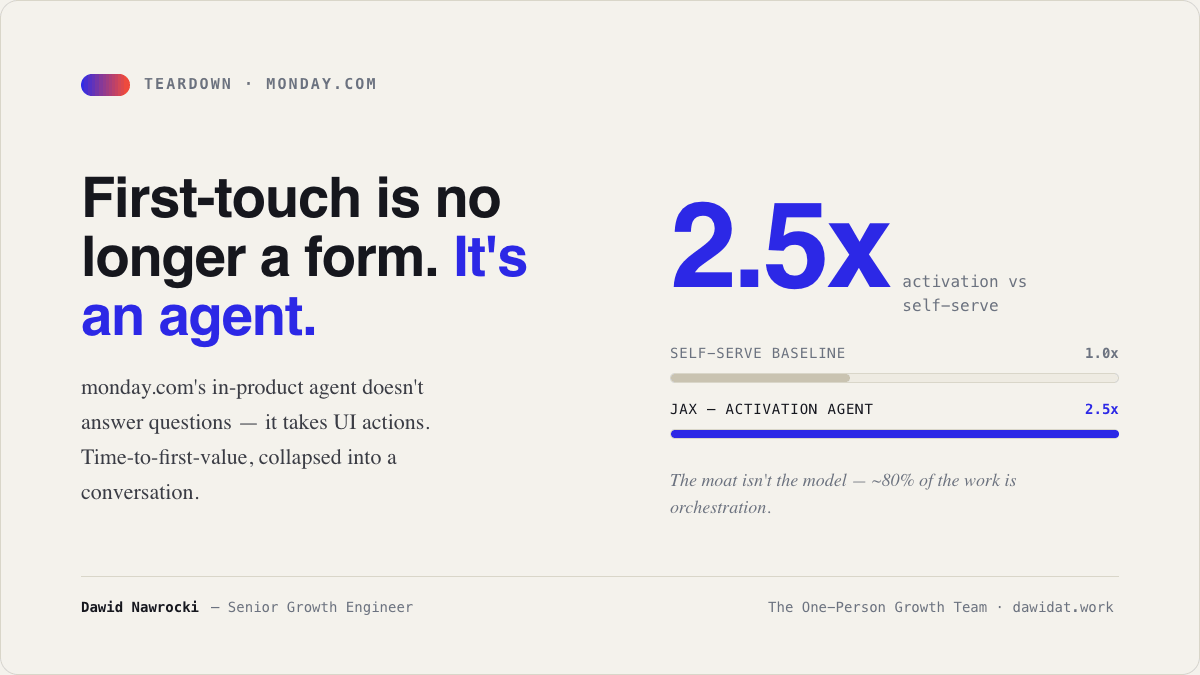
Jax is the one worth zooming in on. It’s live in the product, and it doesn’t just answer questions — it takes UI actions. A new user says “I want to track my agency’s client projects” and Jax builds the board, sets the columns, invites the flow. The result monday.com reports: 2.5x activation versus the self-serve baseline. That’s not a chatbot metric. That’s the single most expensive problem in PLG — time-to-first-value — collapsed into a conversation.
Here’s the contrarian part, and the reason this isn’t a “big model budget” story: the moat isn’t the model. By monday.com’s own account, roughly 80% of the work is orchestration — routing, context-loading, CRM writes, handoff rules, guardrails. The model is a commodity you rent. The plumbing is the asset you own.
“Reps only ever receive qualified, context-loaded meetings.”
That sentence is the whole design philosophy. The agents don’t replace the sales team — they make sure humans only spend time where humans win.
The one-person version: I shipped the same play solo
Why speed-to-lead specifically? Because it’s the cheapest pipeline you’ll ever generate — it’s revenue you already paid to acquire and then left on the table. The canonical story is PayPal’s: an internal audit found 8,000 inbound leads nobody had ever called. Working just that backlog — leads they already owned — drove pipeline up ~50%. No new spend. Just speed applied to existing intent.
So I built the one-person version of the monday.com play. The stack:
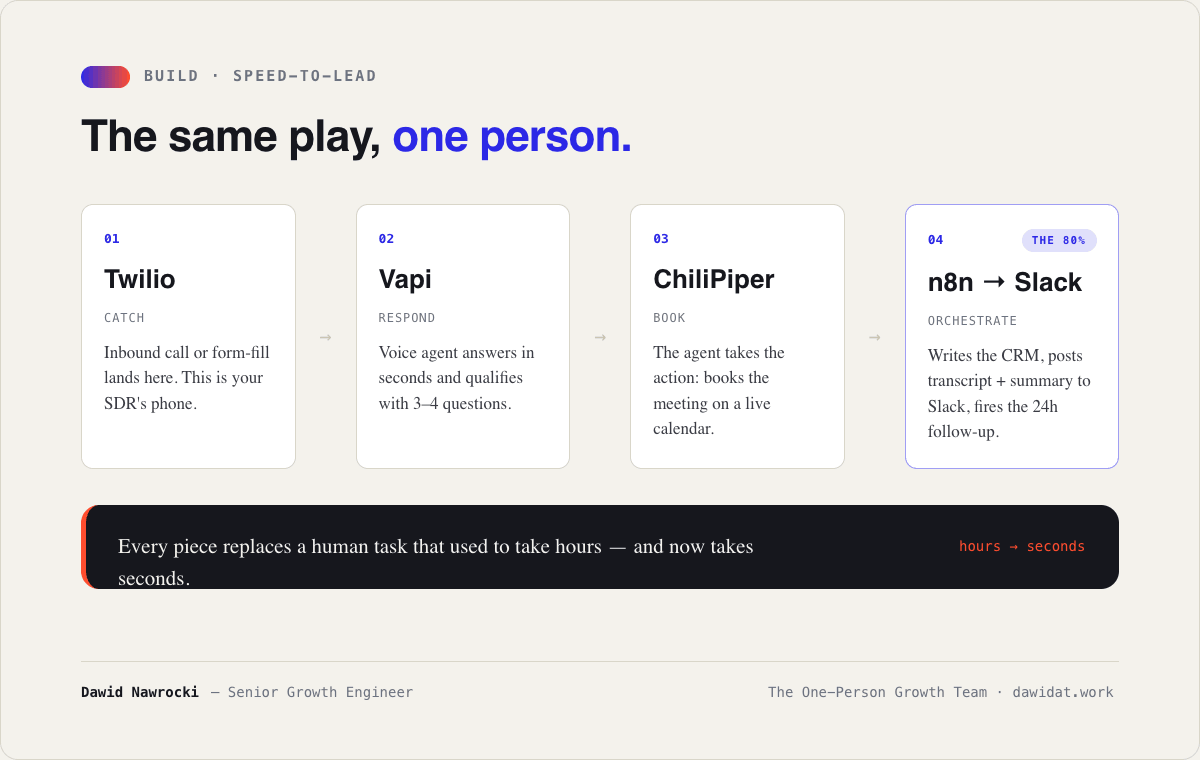
Twilio → Vapi → ChiliPiper → n8n/Slack.
Twilio catches the inbound call or form-fill (that’s your SDR’s phone). Vapi is the voice agent that responds in seconds, qualifies with three or four questions, and — this is the Jax move — takes the action: it books the meeting through ChiliPiper directly on a live calendar. n8n is the 80%: it writes the lead to the CRM, posts the full transcript and qualification summary to Slack, and fires the 24h follow-up if the lead goes quiet. Every piece replaces a human task that used to take hours and now takes seconds.
The honest build-in-public note: the model was the easy 20%, exactly as the monday.com teardown predicted. What actually ate the weekend was latency (a voice agent that pauses 3 seconds feels broken), the human hand-off (when does the agent stop and escalate?), and consent (call recording disclosure isn’t optional, and it changes the opening script). Nobody sells you the plumbing. The plumbing is the product.
So what — the buyer’s 3 moves
Find your slowest first-touch. Measure two numbers this week: inbound response time and trial time-to-first-run. One of them is embarrassing.
Put an agent on the speed layer first, not the whole funnel. Don’t buy “AI transformation.” Buy seconds where you currently spend hours.
Measure conversion and pipeline per agent — not “AI adoption.” monday.com attaches a revenue number to each agent. Copy that, at any scale.
Enterprise or solo, the lever is the same: speed at the moment of intent.
I tear down a real growth system like this every week — subscribe if that’s useful.
I also build these speed-to-lead systems for inbound-heavy teams. If slow follow-up is quietly costing you pipeline, just reply to this email.
P.S. — Reply “stack” and I’ll send you the exact Vapi + ChiliPiper + n8n wiring as a one-page diagram.