

Ashby just posted a role called “Director, GTM Engineering & Systems.” The band: $240–263K plus equity. That number is doing something more interesting than it looks — it’s putting a premium on a job nobody agrees on the definition of.
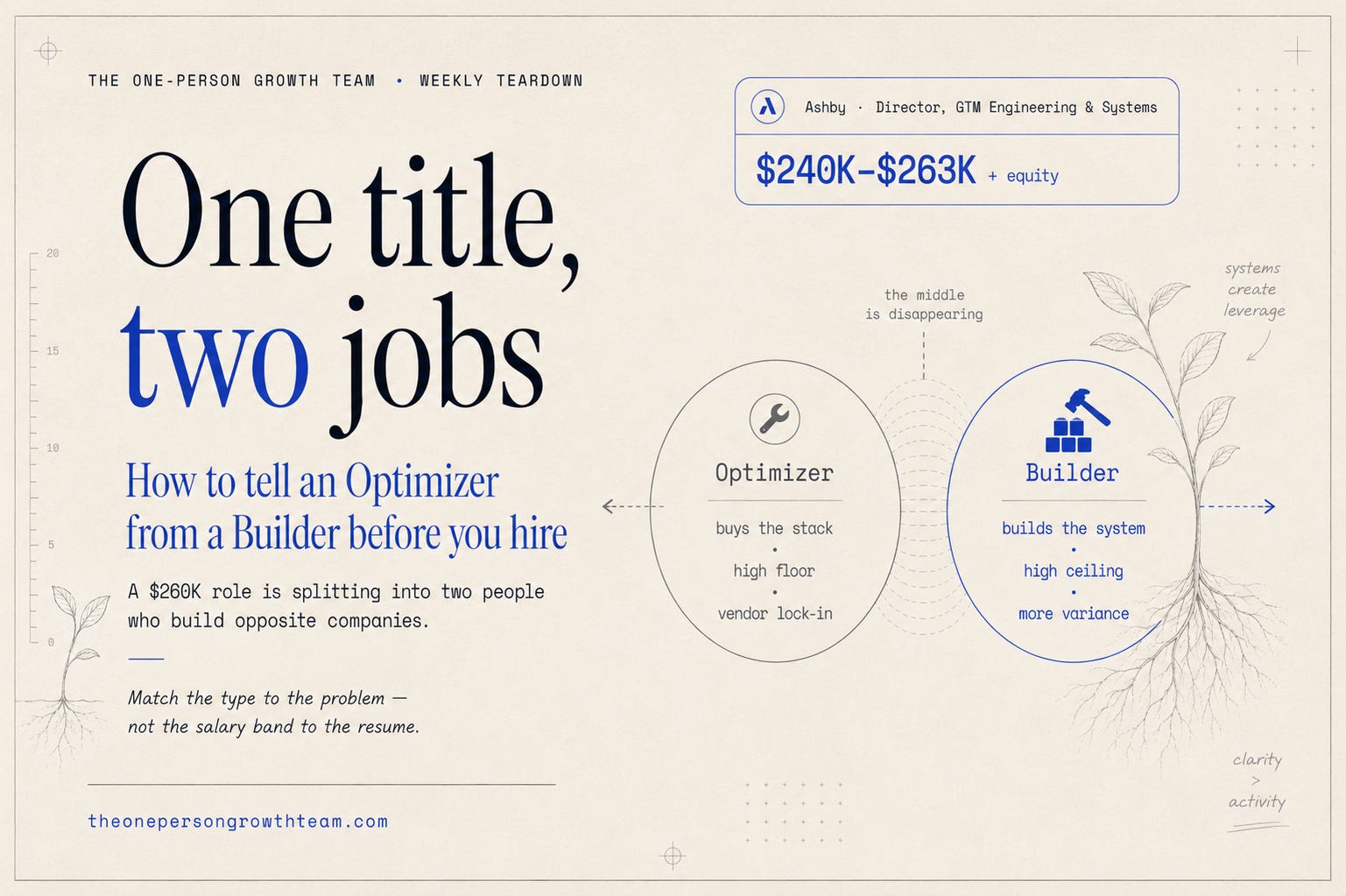
Inside that one title are two different people who build two different companies. And if you’re a Series A or B founder about to make this hire, picking the wrong one is a six-figure mistake. Here’s how to tell them apart before you sign the offer.
The middle is disappearing
Adam Schoenfeld has a read on where the GTM org is going: it’s barbelling. On one end, Builders and their agents. On the other, brand and narrative Creatives. And the vendor-managers in the middle — the people whose job was to own the stack and keep the tools talking — are thinning out.
This isn’t a hot take. It’s a hiring pattern you can watch in real time. Line up the active JDs at Airwallex, Legora, Algolia, Applecart, and Notion next to the Ashby band, and the shape is the same everywhere: companies are paying up for the ends and quietly hollowing out the middle.
Which matters for one blunt reason. If you staff the middle, you’re hiring into a function that’s shrinking. The safe-looking hire is the one aging out.
The two people fighting for that title
The Optimizer (Type A) comes from RevOps or MOps. Their instinct is to take the workflows you already have and modernize them with AI-native software. Hand them a mess of tools and they’ll pick a clean stack, wire it together, and make it hum. High floor, fast time-to-value — and a low ceiling, plus whatever lock-in comes with the tools they chose.
The Builder (Type B) comes from engineering or technical growth. Their instinct is to build the system itself — Claude Code, MCP, a CDP, a warehouse. When the capability you need doesn’t exist as a product yet, they make it exist. Higher ceiling, more variance, and a bigger compliance and maintenance surface to own.
The Optimizer (Type A)The Builder (Type B)BackgroundRevOps / MOpsEngineering / technical growthDefault moveChooses a stack and makes it run cleanBuilds the system that doesn’t exist yetWorks inAI-native software you can buyClaude Code, MCP, CDP, warehouseStrengthHigh floor — reliable, fast to valueHigh ceiling — creates net-new capabilityCostLow ceiling, vendor lock-inMore variance, compliance + maintenance surfaceFails whenThe tool they need doesn’t exist yetAsked to babysit vendors — gets bored, leaves
Neither is better. That’s the part most job posts get wrong. They fail in opposite directions — and the whole game is knowing which failure you can’t afford.
The one question that sorts them
Here it is:
Is the growth system I need already possible with tools I can buy — or does it not exist yet?
Already possible, just needs to run clean → hire the Optimizer. Doesn’t exist yet → hire the Builder.
That’s the whole decision.
The mismatch is where the money burns. Pay a Builder $260K to babysit vendors and they’ll leave inside a year — the work is beneath the thing they came to do. Ask an Optimizer to architect a system from zero and they’ll stall, because their strength was choosing, not creating.
You can catch this in a single interview move. Ask the candidate to walk you through the last system they built — then the last stack they chose. Listen to the verbs. “Built,” “wrote,” “designed from scratch” is one person. “Evaluated,” “selected,” “rolled out” is the other. The verb reveals the type faster than any resume.
The one idea to keep
The title is converging while the job is diverging. Every company will post some version of “GTM Engineer,” and the comp bands will keep climbing faster than anyone’s clarity about what the role actually does.
So don’t match the salary band to the most impressive resume. Match the type to the problem you can’t yet solve. That’s the only version of this hire that pays for itself.