

For fifteen years your pricing page has been built for one reader: a human with a mouse, a scroll wheel, and enough patience to wait for a table to load.
That reader now has company. The other one doesn’t execute JavaScript, doesn’t scroll, and doesn’t give you the benefit of the doubt when a number fails to appear.
Here’s the part that should get your attention: when a buying agent can’t get your price from you, it doesn’t come back empty-handed. It gets the price from G2, from Vendr, from a competitor’s comparison post. Someone answers the question either way. The only variable is whether it’s you.
Below: the numbers, the three distinct ways this fails, and a ten-minute test you can run on your own site before you finish this email.
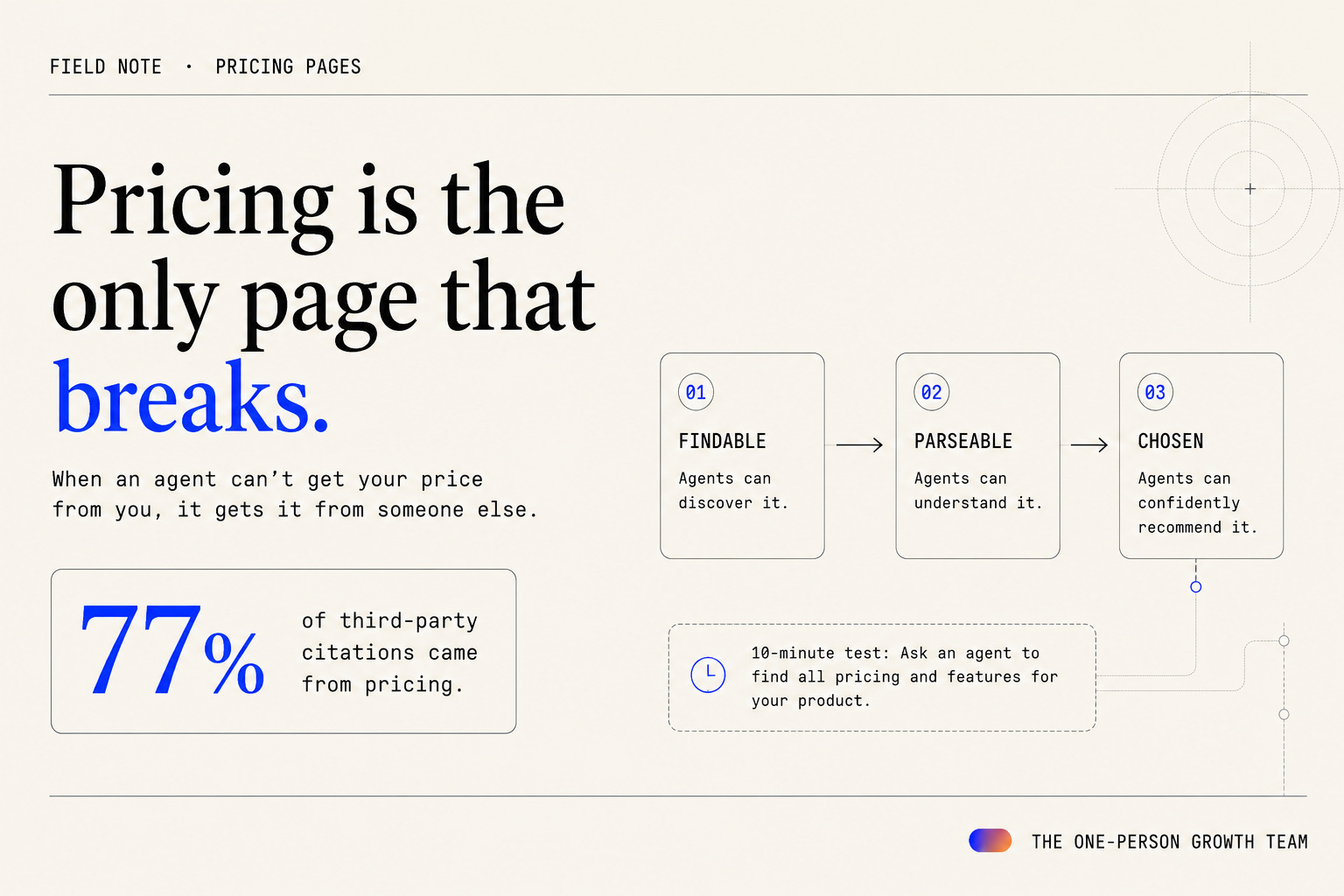
Pricing is the only page that breaks
The setup, from Kevin Indig’s study with Siteline: an agent was given three buying tasks — pricing and features, integrations, security — across 100 B2B products, five runs each. 1,500 runs total. No links were handed over. The agent had to find each vendor the way a real buyer’s agent would.
Integrations got answered from the vendor’s own site 93% of the time. Security, 92%. Pricing: 79%.
And pricing generated 77% of every third-party citation in the entire study.
Say that plainly. On security and integrations, you are the source. On price, one time in five, somebody else is.
Of the 580 third-party pricing citations, 52% came from editorial content and 46% from directories — G2, Capterra, Vendr, Tekpon. Which means the number a buyer sees is a number someone else published, at a date you don’t control, with a discount assumption you never made.
Nobody has “we lost authorship of our own price” on a dashboard.
Three ways a pricing page disappears
These are three different failures with three different fixes, and only one of them is a decision anyone actually made.
1. Opacity — there’s no price. 14% of tested products publish no pricing anywhere; in Marketing/Sales and Customer Support categories it’s closer to a third. When the agent hit a no-price vendor, 45% of runs cited at least one third party. Gating price is a legitimate strategy. It now has a line item attached: G2 fills the gap, and G2’s number is your number as far as the buyer is concerned.
2. Machine-readability — there’s a price, but it can’t be parsed. Zendesk’s pricing table renders client-side in JavaScript. The agent doesn’t execute JS. A person sees a full price list; the agent saw a blank page. This is the one that stings, because nobody chose it, nobody owns it, and it sits in no one’s KPIs. Your pricing page can be perfect and invisible at the same time.
3. Access friction — the agent never reaches you at all. Braze couldn’t be reached in the study; the agent pulled its numbers from G2 and Vendr instead. Access errors showed up in only 7% of runs — small enough to look like noise.
It isn’t noise. On normal runs, third-party fallback ran at 17%. On runs with an access error, it hit 77%.
That’s not a linear relationship, it’s a threshold. A 7% failure rate produces a 4.5x swing in who answers for you. Which is exactly why an audit is cheap relative to the exposure — you’re not optimizing a curve, you’re checking whether a switch is flipped the wrong way.
The fix is boring, which is the point
Adding schema.org Product and Offer markup with price and priceCurrency moved one tested page from 73 to 93 on a readiness score. One lever.
And here’s the detail that should end the internal argument about whether this is a positioning problem: a well-known B2B pricing page scored 73 on one run and 92.5 on another. Same page. Same hour. The 20-point spread came entirely from how the page happened to get fetched.
Nothing about the copy, the tiers, or the value metric changed. This is infrastructure, not strategy.
Fixing the page still isn’t winning
Now the honest part, because I don’t want you to fix your markup and declare victory.
Even when a vendor showed a real, public, numeric price, agents still cited at least one third-party source in 18% of runs. Publishing doesn’t buy exclusivity. It buys you a seat.
And single-shot visibility measures almost nothing about who wins the deal. Arnav Narang ran high-intent buying conversations out to five turns and watched one brand’s share of voice fall from roughly 100% to roughly 10% — not because of anything the brand did, but because ordinary buyer constraints entered the conversation. Team size. Budget. Compliance. The stuff that shows up in every real deal by turn three.
So the frame I’d leave you with is three moments, not one:
findable → parseable → chosen.
A team that fixes only the first will lose at the third, and will never see it in a report.
Run the test yourself — ten minutes
Not a hypothesis. A finding, about your site, today.
Ask an agent: “Find all pricing and features for [your product].”
Run it three to five times, not once. The study found the same page scoring 20 points apart across runs — one clean result tells you nothing.
Read exactly three things: Did it get a number? Was the number right? What did it cite?
If G2, Vendr, or a comparison blog appears in the citations, stop looking for a cause. That’s the finding.
Then push it to five turns with real constraints — “we’re 40 people, budget is $2k/mo, need SOC 2” — and watch whether you’re still in the answer at the end.
If you want ongoing numbers rather than a spot check: Microsoft Clarity’s new Bot Activity report separates AI crawlers from AI assistants fetching a live answer for a user in the moment. Worth having. One catch — it needs a CDN connection to see this traffic. The JS snippet alone won’t catch it, for the same reason the agent couldn’t read Zendesk’s table.
Your pricing page has three ways to disappear, and you only chose one of them.
Making growth surfaces machine-readable is most of what I do these days — if you run the test above and don’t like what you see, reply and tell me what it cited.